





Helping Your Child Heal: Incision Care

Life-Threatening Emergencies
If your child is facing a serious or life-threatening emergency, please call 911 immediately.


Keeping Your Child's Incision Clean After Cardiac Surgery
Incision Care
- If your child has surgical skin glue:
- Your baby's incision may be closed with non-dissolvable stitches or dissolvable stitches +/- a clear skin glue.
- The skin glue will naturally loosen as the incision heals. You can expect it to last anywhere from 5-14 days.
- Do not let your child pick or scratch at the skin glue or incision site.
- Non-dissolvable stitches will need removal by a healthcare provider about 10-14 days after placement.
- Always wash your hands before touching the incision.
- Keep the incision clean and dry.
- Avoid submerging the incision in water.
- A cover/dressing is not always necessary.
- Reasons to cover your child’s incision with a bandage:
- Your child’s chin rubs the top of the incision
- Your child spits up, drools, or scratches at the incision
- Then you should apply a clean, dry dressing and change it daily.
- Reasons to cover your child’s incision with a bandage:
- Protect the incision from direct sunlight for one year by using SPF 30+ sunscreen.
Monitoring
- Check the incision daily for redness, swelling or drainage, which may be signs of infection.
- Contact the Cardiac Surgery team if you notice any signs of infection.
Bathing
- For bathing, use a sponge bath or an infant tub with water only covering the lower body.
- Use a clean towel just for the incision site. Do not use the same towel you use for the rest of your child’s body.
- Prevent direct water pressure on the incision.
- Wash around and gently over the incision with water and promptly pat dry, avoid rubbing.
- It’s important that the incision is completely dry after bathing or cleaning.
Incision Cleaning
- Perform incision cleaning daily, regardless of daily baths.
- Gently remove any bandage and inspect for changes.
- Soak gauze or a clean towel with Vashe (wound solution).
- Gently pat the incision with soaked gauze/towel to clean it, avoid rubbing.
- Pat dry with a dry gauze or a clean, dry towel.
- Apply a new bandage if necessary.
- Avoid applying lotion, ointment or powder unless instructed by your healthcare provider.
Common Incision Findings
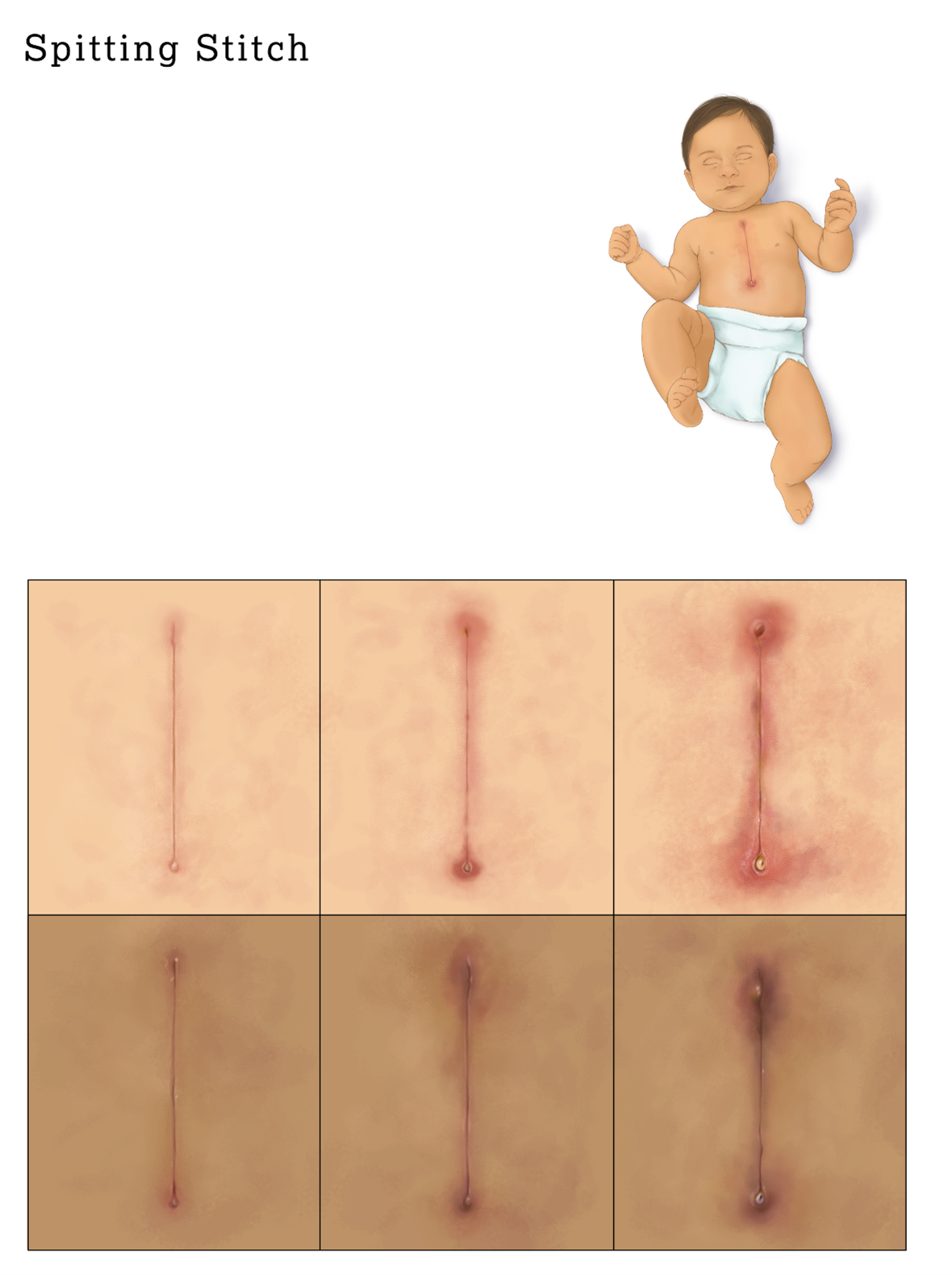
- In children under one year old, it is not uncommon for small reactions to appear at the top and bottom of the incision. This is where the knots are tied, and the body might react to them by pushing the stitch through the skin. This is called a “Spitting Stitch” and there is a picture of it below.
- A small, raised bump resembling a pimple, sometimes surrounded by redness, may be seen.
- It's not always an infection, although it looks similar.
- This mostly occurs three to five weeks after the operation; it is less likely after six weeks when the incision is more stable.
- If you notice a reaction like this with your child's incision:
- Take daily pictures and send them to the Cardiac Surgery team email
- Apply a warm compress to the area.
- Do NOT try to pop or drain the bump.
- Clean daily with Vashe and cover with a bandage.
- Not all reactions will need antibiotics.
- Watch for worsening or spreading redness.
- If your child has a fever that doesn't go away with Tylenol, go to the emergency room.
- Be patient and give it time to heal.
Spitting Stitch Illustration


Get Well Network
Access patient health education videos to help you and your family after your child's hospital stay.

Nominate an Outstanding Nurse for the Daisy Award
The nurses at Children's National are trained to provide compassionate care for young patients. If you received exceptional care during your hospital stay, nominate your child's nurse for the Daisy Award.